
Sebastián Moreno
Universidad ORT Uruguay
8 January 2025
(Palermo, 11-13 December 2025)
What do Judas, the Joker, Ivan the terrible, witches, werewolves, the Devil, Adolf Hitler, Donald Trump (and his signature), ravers, prisons, the military in South American countries, mother nature, artificial intelligence and barbarians have in common? One possible answer is that they were all addressed during the 53th Italian Congress of Semiotics, which took place in Palermo from 11 to 13 December 2025 under the auspices of the Italian Association for Semiotic Studies (AISS), the Department of Culture and Society of the University of Palermo, the Sicilian Semiotics Circle and the Antonio Pasqualino Museum. It was in the Museum that the Congress took place, as did in 2022.
For anyone interested in social and cultural semiotics, the Congress felt like being in paradise. As the organizers reported during the members’ assembly, around 120 presentations were scheduled for the three-day event. As is usually the case in the annual congresses organized by the Italian Association for Semiotic Studies, presentations were held by professors, researchers and students, who regardless of their professional status sat together in the many panels of the Congress to discuss about cattivi, that is, the wicked. This was the theme of this year’s conference, following those of silence (Bologna, 2024), living together (Rome, 2023) and matter (Palermo, 2022).
The event was opened with welcoming greetings by representatives of the organizing institutions. Then, a presentation by Isabella Pezzini followed, where she presented a short clip of an appearance of Umberto Eco — 2026 marks the 10th anniversary of the passing of the Italian semiotician — in the television show Babau. Three keynote lectures followed: one by Juan Alonso Aldama on the time of evil, one by Stefano Traini on Judas and finally one by Alice Giannitrapani on styles of being wicked. In the afternoon, parallel sessions organized around the topics of the sacred and the profane, voices, wickedness (cattiverie), comic strips, ideologies, philosophies, artificial intelligence and media closed an intense first day of activities.
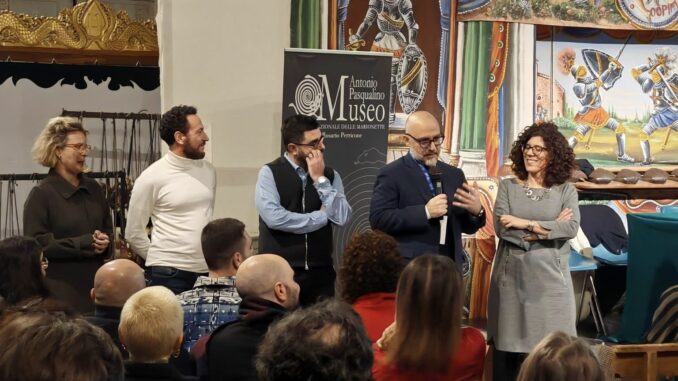
The second day began with two keynote lectures. First, Anne Beyaert-Geslin discussed the relationship between wickedness and veridiction. Then, Cristina Demaria and Mario Panico jointly discussed different modes of depicting women as wicked, in a presentation informed by several examples. The parallel sessions resumed once his first session was finished, this time on the themes of true crime, bad taste, devices of power and stories. After the lunch break, Rayco González delivered a keynote lecture on Spanish right-wing politics with a focus on the demonization of the political enemy, and Rosario Perricone discussed the role of the traitor in the Sicilian puppets, in a gracious presentation that including a live performance with the marionettes displayed in the Museum. After that, parallel sessions on the themes of heresy, war, atmospheres and videogames followed.
The second day finished with the annual members’ assembly, during which the current directive of the AISS, led by Dario Mangano, presented the Association’s balance and a recap of some of the activities they developed in 2025. The current directive, led my Mangano but also consisting of Maria Cristina Addis, Gabriele Marino, Francesco Mazzucchelli and Paolo Peverini, finished its mandate and a new directive, led by Piero Polidoro and with Giuditta Bassano, Remo Gramigna, Mario Panico and Ilaria Ventura as core team, was approved by acclamation.
On the third and last day of the congress, parallel sessions on the themes of politics, aesthetics and transmediality took place (it was in the panel on politics that I presented my analysis of the actantial role and depictions of the military in post-dictatorial memorial discourse in South Americ). Two keynote lectures closed the event: Alessia Cervini discussed the film Ivan the Terrible, by S. M. Ejzenstejn, and Denis Bertrand elaborated on Judas, somehow proposing a circular closing of the event since the he was also addressed during the first morning.
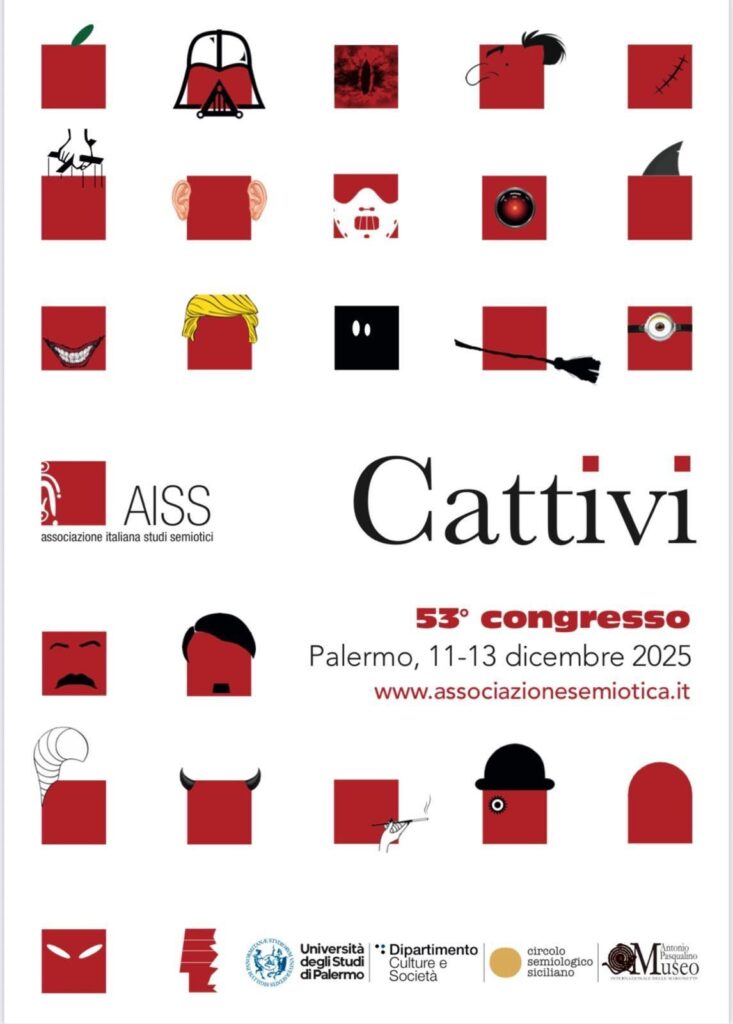
A puzzle-solving game was proposed by the organizers since the first day. It consisted in discovering who were the wicked that the 24 red squares featured in the event’s flyer stood for. The final session of the congress included the solution, which revealed the few characters that nobody managed to identify. Do you think you can discover them all?
As is the case every year, the Italian Congress of Semiotics did not disappoint. Presentations gave enough food for thought, discussions were rich and semiotics grew in its theoretical and analytical dimensions, but also in its dialogue with other fields of knowledge, which is crucial for its interdisciplinary scope. For researchers not based in Italy like myself, it is also enjoyable to feel the welcoming attitude of members of the vibrant and collegial community of semioticians in Italy. During the congress, it was evident that this academic community, working together, addressed the issue of the wicked with excellence, diversity and also fun.
Be the first to comment