
Review of Chris William Martin and Diana McGlinchey, Reading Graffiti: The Semiotics of
Street Art
By Gary Genosko
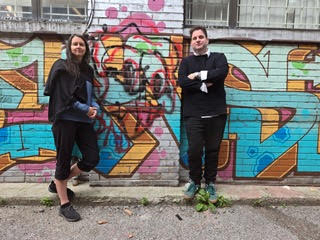
The dynamic definition of graffiti that the authors adopt – “to act against a surface” – emphasizes encounters with surfaces in specific locations. While canvassing some foundational distinctions between graffiti versus street art as word versus image, and gathering a working vocabulary of graffiti, such encounters are treated as “artistic practices” that rattle what sociological theorist Erving Goffman once called “civil inattention,” engaged with here in terms of how we relate to both strangers and strangeness. Moreover, ideas like Umberto Eco’s semiotic guerrilla actions are canvassed that “intervene within the interpretation of the original sign with a new meaning” and lend to graffiti a critical edge, perhaps even a meta-functional critique of social structures. Graffiti re-signifies the “semiotic landscape” of the city. Despite all of the wars on graffiti, like those in the US in the early 1970s, and against the so-called vandals who practiced it – a war periodically restaged and opening new fronts – graffiti persists. In urban terms, graffiti calls into question the interests of private property and wages a struggle over the “right to the city.” Community value is balanced against property in compromises like Toronto’s graffiti alley and other “designated” graffiti areas. Are these zoned bohemias anything more than examples of artificial negativity, the loss of genuine conflictuality that absorbs antagonistic alienation and reproduces it from above as planned, regulatory and one-dimensionalized opposition? Without artificial negativity, does neo-liberal capitalism go crazy? With organic negativity, space for critique is not readymade and waiting, such that maturation within the neo-liberal city gives some room for the leftovers from below, glocals linked in diverse assemblages engaging in anti-totalizing communication, to take unanticipated actions in unpredictable locations. An interview with street artist SAM (StreetArtMiniature) in Ottawa reveals the protective secrecy of her identity and an object lesson in semiotic analysis and its limits. The polysemy of her miniatures, like the image of a fudgsicle, relies on mystery, foregrounding in encounters with it a rawness, yet social media adequate presentation, all the while aiming to disrupt civil inattention of sleepwalking pedestrians. A semiotics of these miniature food items begins with a contrast with monuments; they survive due to their unobtrusiveness, their smallness, as not even renovations harm them. A semiotics of the secret world of miniatures, a miniscule world without authorship, displays denotative and connotative dimensions, and sits among markers in larger works that index music of an era (90s rock), and technologies of the time (payphones and plastic milk crates). It would be worthwhile to extend the analysis of these material objects to the telecommunication system hackers and vinyl record collecting sub-subcultures that also resignify them. Does semiotic analysis get in the way of street art’s capacity to function against signs?
This seems like an easy question to answer – yes, if you put it that way! – but it is never easy to pose and meet this challenge, as Jean Baudrillard once attempted. Baudrillard’s position seems to fly in the face of semionautical ambition. Harkening back to New York City in the early 1970s, Baudrillard regained the proliferation of tags on subway cars in terms of the urban fabric’s own semiocratic logic of differences, not in order to study the delicate denotative and connotative arrays of graffiti, but to argue that these abstract names did not mean anything: they were “empty signifiers” and that is what made them powerful and impactful. Instead of disturbing inattention, they deterritorialized an already heavily mediatized urban environment, erupting through incantation, even “tattooing walls … like archaic effigies.” They were anti-signs, and for a time, they did resist capture, until they were given meaning by the art market. Indeed, Baudrillard’s passing use of “tattooing” points forward to the links between graffiti and tattooing practices. Certainly, this is terrain Martin has explored before. The tattoo connection is looped through an interview with street artist Eryn O’Neill in Ottawa, via the appearance of his book The Social Semiotics of Tattoos in one such parlour. O’Neill’s “kinship” with tattoo artist arises through her pursuit of “desire paths” or roaming, materially manifest in her interest in traffic cones as transmitters of cultural messages (not mentioning German electronic band Kraftwerk’s iconic album covers between 1970-73 featuring different coloured traffic cones). But the messages sent by O’Neill or the “men at work” of Kraftwerk are not open and free. Even abstract concepts like arbitrariness encode privilege and parasitically invite familiarity and its reproduction. Meaning does not run on infinitely, but rather lays down constraints, like the urban environment itself. Detours and swerves, like significations, are subject to a degree of supervision and the overcoding of protest codes that follow subcultural rules that guide practices with regard to, for instance, tagging existing street art (or even tagged safety cones). Adopting a criminological perspective, enhanced by the lens of a critical media discourse analysis, it is then proposed to analyze graffiti by foregrounding its threat to property (public and private), its linguistic negativity, and its place among the broken windows approach to crime. Media language tends to conflate graffiti with vandalism, and the need to “restore” graffitied
sites to their original state, before they trigger decline. Overall, the selected media reports studied
by the authors from 2025 tended toward the neutral; tags were negatively assessed, and positive
assessments were rare. The strength of the abovementioned conflation is such that even legal
walls for street artists do not disrupt it. In some cases, public endangerment is used to bludgeon the public (the recent ‘Pam the Bird’ case in Melbourne, Australia is discussed) into accepting an
assessment that graffiti constitutes an “attack” on the community, a pattern repeated in examples
drawn from Canada, the US, and elsewhere. The consideration of property is based largely on time and task: how long does it take to remove the graffiti, by whom, and at whose cost? The imbalance between private responsibility and public inaction is fairly profound. Yet there was still room to praise graffiti on the grounds of public enjoyment. A few clever scratchings from the annals of latrinalia are canvassed to
demonstrate that the golden age of graffiti was in the past (indeed, an entire semiotics of the
decorated latrine is warranted and greatly anticipated). And some street art may add value to a site, demonstrating the area’s vibrancy, youthfulness, and creativity. While current political issues inform graffiti’s content, as much as the ideological struggles of the day shape hate speech vandalism, the role of law, at least in Canada, veers towards using the charge of vandalism, with street artists commenting that they have been approached by bylaw enforcement officers, pursued by security guards, and harassed by police. With the reproducibility of graffiti on social media serving as an updated platform for historical expressions of rebellion (noting @radicalgraffiti on Instagram and Peter Kropotkin’s Words of a Rebel circa 1885 ), the question of “who owns what?” provides a segue to a semiotically informed theory and practice of disobedience inspired by Umberto Eco’s urban semiotic guerrillas.
Figuring Banksy as a culture jammer, Martin and McGlinchey utilize one of his major resignifications in Paris circa 2018, the painting by Jacques-Louis David, Napoleon Crossing the Alps (1801-5), featuring a red cape draped over Napoleon’s eyes as he leads blindly his army.
This resistive tactic can, in Eco’s terms, foil and foul the solidity of French cultural and historical
messages, exposing this equestrian mountain scene as a phantasy, but deflating the exaggerated handsome hero dressed in finery, commanding a fiery steed in rough terrain, leaving only a
punctured romanticism and contemporary questions about the poor political sense of then current
French government especially towards border-crossing refugees. New narrative worlds, mounted from below, can be circulated and subject to their own meta-commentaries (like Ottawa’s Mark Adornato’s riff on Bansky’s The Banality of Banality of Evil), with new layers of irony and satire. Irony is an engine of counter-meaning, of what C.S. Peirce called an acritical inference, blind like Banksy’s Napoleon, and unsure of the general principle. Guided by force rather than reason, irony gives way to satire which is grounded in an articulated and shared intertextuality between producer, active viewer/reader, and text/image. The difference between irony and satire is explained this way: “Irony and satire depend on the audience in the production and consumption of meaning. While irony need not have an audience be a critically thinking participant, satire ideally does.” In order the get the full effect of singerie in the intertexuality of a Banksy piece like his oil painting Devolved Parliament (featuring monkeys, not elected
politicians), the 18 th century Rococo substitution of monkeys for humans must be understood as the comedic origin, the depth and stability of art historical monkey tricks giving way to a contemporary critique of political intelligence, with apologies to actual monkeys, of course. In a fulsome account of Adornato’s artistic pursuits, his “reverence” for graffiti art remains robust, yet he has, he admits, aged out, and works in public with wheatpaste, simulated surveillance, and guerrilla gardening. Seed bombing and “brandalism” (and jabs at the culture industry, and financial industry) keep Adornato busy. A spray can has given way to a rake. Yet it is Bansky who gets the semiotic guerrilla exemplary status with his self-shredding painting “The Girl with Balloon” of 2018 at Sotheby’s auction house in London, despite a lingering ambivalence about him by some of the artists interviewed by Martin and McGlinchey.
But what Bansky does is force us to rethink his precursors and how their contributions can be
rewritten (Duchamp’s readymades, Pollock’s splatter paintings). Regaining Goffman’s dramaturgical analysis and the importance of the three intersecting factors of time, place, and audience, as well as Paul Bouissac’s questions about how to semiotically analyze a live event in his studies of the circus, Martin and McGlinchey look at how intersections yield unique social interactions in the case of the Secret Walls mural competition in Ottawa. Noting, additionally, that the positions of spectators/observers tend to blend, and bend back into auto-ethnography, combing both front stage (display) and back stage (preparatory techniques) dimensions. Focusing on a live street art performance competition, the “dramaturgy of improvisation” yields an understanding of a performance plan that answers to temporal restraints; indeed, all such rules (of colour, medium) both enable and constrain, as the teams move toward unified objectives. The resulting murals signify not through hostility but rather, through generosity and respect, recirculating known signifiers from within graffiti styles, and quotes from specific artists; ultimately, “dramaturgical discipline” is rewarded by audience responses. There is, then, a question of fragility. In tracing the relationship between graffiti and tattoo artistry, the ephemerality of paint is weighed against inroads into permanence in the made-to-fade options and removal service sectors. Even fieldwork can be cancelled, as we learn in the case of a scheduled research appointment with Alan Ket, director of the Museum of Graffiti in Miami, FLA. There is a kind of “pipeline” between graffiti and tattoo artists, and both practices have an arcana of tool talk – spray can nozzles (caps) and tattoo cartridge needles. Even stickering is a street art that overlaps both practices. All of this is simply, as Zygmunt Bauman called it, symptomatic of liquid modernity, with its fading frames of reference, withdrawals of the welfare state, and short-term thinking. Still, it is undeniable that figures of “outsider” and “outlaw” street artists and tattooists have achieved a significant amount of mainstream recognition and accommodation, not to mention popularity. With this volume Martin and McGlinchey deliver a primer on decoding street art, advocating for the need to semiotically analyze the cityscape in its marked and unmarked dimensions. The marked elements that stand out and richly signify are contrasted with the unmarked, rather neutral features that are less semiotically vibrant. What kind of city do you want? One like Ottawa with an unmarked functional modernism, a colourless, anodyne downtown, that slowly came to life the more it was marked by street art? The authors answer with a resounding ‘yes’. While there is an intended irony in this, some of the most compelling sections of this book were based on events and interviews in Ottawa (and in other Canadian locations) with street artists at their favourite haunts as well as at sanctioned graffiti events. No reader of this book will ever again uncritically accept the received wisdom that Ottawa is boring.

Gary Genosko is Professor of Communication and Digital Media at Ontario Tech University. His
recent books are as author, Harley Parker: The McLuhan of the Museum (2025) and as editor,
Harlery Parker, The Culture Box: Museums as Media (2025).
Be the first to comment