
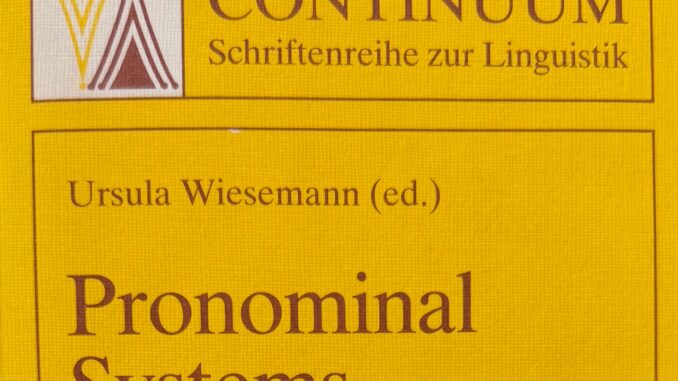
Pronominal Systems: Patterns of Change in Perspective
Paul Bouissac (University of Toronto)
- Linguistic lability
Let us consider some of the morpho-syntactic and pragmatic changes that have occurred recently, or are currently happening in the pronominal systems of some European languages. The impact of political and ideological movements on language usually makes these changes obvious because of their relative suddenness, and the debates they often trigger in the population and the media. Top-down modifications of previously accepted pragmatic norms and the introduction of new forms of pronouns are willingly endorsed by some but met with resistance by others who object to what they consider to be an adulteration of their national language. For instance, on November 1, 2023, The French daily Le Monde reported that France’s Senate voted for an extensive ban on gender-inclusive writing. A day before, President Emmanuel Macron, had weighted upon this decision by stating in an official speech that “[i]n this language, a masculine noun acts as the neutral form. There is no need to add dots or hyphens in the middle of words”. This kind of resistance is all the stronger when a language like French has been historically consolidated in its written form and supported by conservative institutions such as academies, libraries, and compulsory public instruction toward universal literacy within the administrative confines of a country.
However, the perceived stability and permanence of a language is largely a temporary cultural artefact that masks the long-term dynamics of this means of communication among humans. All languages in their spoken form keep changing more or less subtly over time from generation to generation, a phenomenon compounded by the fact that, within a monolingual national area, countless regional variations, themselves submitted to spontaneous changes, can be noticed by outsiders but remain mostly below the threshold of awareness in the general population. The 19th century Swiss linguist Ferdinand de Saussure emphasized this natural lability of language by pointing out that over the past two millennia in Southern Europe nobody noticed that they were no longer speaking popular Latin and started to speak what was to become French, Italian, Spanish, Portuguese, and Romanian for instance, at a time when literacy was far from being universal. He further suggested a thought-experiment: suppose you make photographs of a person every year and, at the end, hang all the portraits side by side. It is difficult to perceive marked differences from one to the other, but striking changes appear if one skips ten or twenty of them (Saussure 2006).
The bottom-up process of change is always at work in any language. Native speakers who leave their country for a lapse of time usually need a period of adaptation when they return as they notice differences in intonation, pronunciation, lexicon, and even syntactic patterns that have emerged in the meantime and have been spontaneously adopted by their native speaking community, a process reinforced by the daily influence of public radio and television. Spoken natural languages are a moving landscape. Both internal drifts and outside pressures feed a dynamic that is difficult to conceptualize and predict.
We have to keep in mind this background dynamics of natural languages when scrutinizing methodically well-defined changes under the lens of today’s pragmatics in the wider framework of the life of languages in societies, as the familiar metaphor of the tree versus the forest suggests if it is transposed on the temporal axis. From the synchronic point of view, pronouns can be construed as consistent, stable systems defined by morpho-syntactic and pragmatic rules. However, from the diachronic perspective, the comparative linguists who have endeavored to come to grips with the evolution of pronouns from Proto-Indo-European to the various Indo-European languages, have been challenged by the diversity, complexity, and instability they encountered (e.g., Meillet and Vendryes 1953: 493; Fortson IV 2010: 140-143; Beekes 1995: 201).
- Address pronouns and beyond
The ways in which various second-person pronouns are used to address others in casual and formal interactions are usually consider to belong to the domain of politeness, thus suggesting a measure of optionality. However, address systems pertain to the very social fabric and polity of a population, and transgressing the cultural norms that regulate mutual language interactions is more consequential than minor communication infelicities would be. While English has generalized a single all-purpose second-person pronoun, “you”, many other European languages maintain strong distinctions that consolidate social hierarchies and conventional expectations regarding the mutual status of the interactants. This is why political ideologies bent on social engineering are prone to impose address norms that are designed to transform symbolically the very social structure of their society.
Indeed, address pronouns are not merely conventional tools that regulate verbal and written interactions according to the principles of politeness and propriety that pertain to a particular socio-cultural context. They are the symptoms of forms of polity. Models of societies that were developed by socio-linguists and anthropologists provide such a framework to interpret the pragmatics of address pronouns beyond a purely descriptive level.
Inspired by Basil Bernstein’s theory of restricted and elaborated language codes that respectively characterize lower and upper social strata in the British context (1971), anthropologist Mary Douglas developed a general social model contrasting two dimensions she expressed through the metaphors of “grid” and “group” (1970). The former features strong social differentiations and the prominence of individualism; the latter evokes social cohesion and collective bonds. These social models that were further elaborated in great complexity by Mary Douglas and her followers, as well as Basil Bernstein’s theory of codes, provide the most relevant theoretical background to interpret the patterns of change in address systems that are documented in this volume, whether they indicate a tendency toward social integration and communal ideology, or, on the contrary, emphasize status distinctions and hierarchical structures. The latter, incidentally, offer morphological resources for alternations, such as indirect and neutral forms, whenever speakers are challenged by the choice of proper pronouns in ambiguous situations.
Naturally, the dichotomy represented by the metaphors of “grid” and “group”, and their implied connotations of dystopia versus utopia, must not be taken literally. These are two dimensions with respect to which each case can be located. There are usually smaller “grids” embedded within any “group” (for instance, military and religious hierarchies), and smaller “groups” nested within any “grid”, (such as fraternities, extended families, and subversive sub-cultures), each with their own distinctive, possibly secretive system of address. Nevertheless, the opposite notions of “grid” versus “group” considered as a x-axis versus a y-axis provides coordinates with respect to which address systems can be characterized through their position on the curve at any given moment in historical time.
- Gender issues in diachronic perspective
The issue of gender in the morphology and uses of pronouns has generated controversies inspired by competing ideologies, and have received a high degree of visibility through the media, amplified by some topical trade books such as Pennebaker (2011) or McWhorter (2025). It is necessary, though, to identify two very different lines of resistance to such proposed modifications that concern either the traditional pragmatic norms of the existing personal pronouns or the creation of neologisms designed to define new categories and functions. Only time can tell whether instances of innovative morphology are consensually adopted and become part of a language or not.
Furthermore, it is important to distinguish popular and expert objections. The former is usually grounded in conservative common sense ideologies; the latter is motivated by the grammatical difficulties or inconsistencies these changes of pattern may create within grammatical systems themselves as they have relatively stabilized over time, in languages that feature the compulsory gendering of the lexicon (e.g., German and French) in addition to what could be characterized as the biological or cultural gendering of people and things (Rentetzi 2024)..
However, as we pointed out earlier, languages are constantly shifting landscapes. If pronominal gender systems are considered on the scale of centuries and millennia, changing patterns in the morpho-syntactic and pragmatic domains of pronouns is of the essence.
Proto-Indo-European, the common ancestor language that was spoken by a late Neolithic and early Bronze Age population located in the Caspian steppe some four to five millennia ago was tentatively reconstructed through systematic comparison of the historical languages it generated. Using written documents, comparative linguists retraced the evolution that the morpho-syntactic system of the mother language underwent as the population split and spread along several directions southward and westward to form the Indo-European language family. It is generally agreed that Proto-Indo-European did not have what we now call “gender”, that is masculine and feminine. It featured only two grammatically categories: animate and inanimate. Comparative linguists of the 19th centuries and their followers have retraced the evolution that led to the various gender distinctions we observe in modern Indo-European languages (Meillet, A. and J. Vendryes, 1953: 502-510; Beekes, 1984: 201-210; Fortson IV 2010: 141-145). It is hypothesized , based on written language evidence, that marks of masculine agency emerged in the animate domain through the addition of flexions such as “-us” (Latin), “-os” (Greek), or other distinct phonemes. It appears that female names remained unmarked and shared their flexion with plural neutral words referring to undifferentiated collective entities or concepts. Frederick Schwink (2004) has retraced the evolution of the Germanic pronouns from their Proto-Indo-European origin to the three-gender pronominal system of German, thus providing the philological perspective that is needed to understand the current state of this pronominal system and the grammatical problems raised by politically inspired top-down changes.
Of course, that historical perspective explains but does not justify the status quo. Pronominal systems both reflect and perpetuate socio-cultural realities. As Emile Benveniste (2016: 191-195 ) showed in his analysis of the Indo-European terms used in the Bronze Age to designate “marriage”, women were not considered as agencies but were either “taken”, “led” by their husbands, or “given” by their father or uncles. This patriarchal system (Benveniste 2016: 165-170) persisted a very long time as bear witness the Frankish Salic law that excluded females from dynastic successions in Western Europe and laws that denied women the right to vote in modern European democracies until the 20th century. The general picture that transpires from the philological evidence is indeed a downgraded status for women, somewhat assimilated to the category of “chattel” in the patriarchal structure of early Indo-European populations, a state of affairs that current changes are legitimately designed to correct.
- Pronominal systems in the broader context
From the morpho-syntactic and pragmatic points of view, the study of pronominal systems can be construed as a well-defined, self-contained domain of linguistic inquiry. However, we should keep in mind that research on pronominal systems significantly interfaces with several other disciplines such as psychology, sociology, cultural anthropology, and even philosophy.
The latter is eminently represented by the influential book by Austrian philosopher Martin Buber (1878-1965) I and Thou (1970), first published in German in 1923, that inspired the fundamental concerns for alterity and reciprocity in phenomenology and existentialism.
In psychology, research grounded in the interactive relevance of pronouns are found in the innovative work of neuro-scientist Leonhard Schilbach, for instance, with the notion of “second-person neuroscience” (Schilbach et al. 2013). That article is part of a whole issue of Behavioral and Brain Sciences (2013, August; 36. 4), that bears witness to the productivity of the interface between pronominal systems and the neurosciences.
We discussed earlier the relevance of research on pronominal systems for sociology and anthropology, as it yields information about the structure and dynamics of societies. All these considerations should be kept in mind when reading, and reflecting upon the dynamics of pronominal systems.
Pronominal systems are one of the most fascinating aspects of language, straddling pre-linguistic and linguistic times. It is the domain of highly specialized comparative linguists, for instance Vaclav Blazek (e.g., 2014, 2019), a comparative linguist who has contributed extensive research on the historical development, origins, and internal structures of personal pronouns, particularly within Indo-European, but also within other families such as Altaic languages, focusing on how pronouns evolved from older words, their connection to syntax, and their typological variations, rather than contemporary gender-specific pronouns. Another comparative linguist, Harald Hammarstrom, (e.g., 2015, 2024, 2025) has focused, among other aspects of language, on the role of pronouns in language classification and evolution, showing how pronominal systems change and vary across the whole range of the world languages.
Those fundamental, daunting knowledge resources provide the most comprehensive perspectives both spatial and temporal, for appreciating smaller scale patterns of change in the morpho-syntactic features and pragmatic norms of the pronominal systems we observe today. However, this highly specialized research somewhat remains in the margins of the general awareness of the diversity and dynamics of pronominal systems.
Within specific geo-cultural areas, descriptive linguistics and pragmatics have proved to be cumulative sciences to a great extent, but research on language is an open-ended process because this multifarious human endowment keeps changing at various, unpredictable rates in spite of the conservative forces of literacy and ideologies.
References
Beekes, R.S.P. (1984). Comparative European Linguistics: An Introduction. Amsterdam: John Benjamins.
Benveniste, E.. (2016). Dictionary of Indo-European Concepts and Society. Chicago: Hau Book
Bernstein, B. (1971). Class, Codes and Control: Theoretical Studies Toward a Sociology of Language. London: Routledge and Kegan Paul.
Blazek, V. and L. Bicanova (2014). Indo-European personal pronouns: limits of the reconstruction. Linguistica Brunensia. Brno: Masaryk University Press.
Blazek, V. , M. Schwarz, and O. Srba. (2019). Altaic Languages. Brno: Masaryk University Press.
Buber, M. 1970 [1923]. I and Thou. Translated by Walter Kaufmann. New York: Charles Scribner and Sons.
Bucher, I. and R. Freeze (1966). The Distinctive Features of Pronominal Systems. Anthropological Linguistics Vol. 8, No 8. ( Ethnoscience: A Symposium Presented at the 1966 Meeting of the Central States Anthropological Society, Nov. 1966), 78-105.
Douglas, M. (1970). Natural Symbols. London: Random House .
Fortson IV, B. W. (2010). Indo-European Language and Culture: An Introduction. Second edition. Chichester: Wiley-Blackwell.
Hammarstrom, H. (2024). https//Glottolog.org 5.1
Hammarstrom, H. (2025). Pronoun consonant patterns: Deep inheritance or erosion effect?
Luraghi, S. (2011). The origin of the Proto-Indo-European gender system: Typological considerations. Folia Linguistica 45/2, 435- 464.
McWhorter, J. (2025). Pronoun Trouble. New York: Avery.
Meillet, A. and J. Vendryes (1953). Traite de grammaire comparee des langues classiques. Paris: Champion.
Pennebaker, J. W. (2011). The Secret Life of Pronouns: What our Words Say About Us. London: Bloomsbury.
Rentetzi, M. (ed). (2024). The Gender of Things: How Epistemic and Technological Objects Become Gendered. London: Routledge.
Saussure, F. de, (2006). Writing in General Linguistics. Translated by Carol Sanders and Matthew Pires. Oxford: Oxford University Press.
Schilbach, L., B. Timmermans, V. Reddy, A. Costall, G. Bente, T. Schlicht, and K. Vogeley. (2013). Toward a second-person neuroscience. Behavioral and Brain Sciences 36 (4): 393-414.
Schwink, F. W. (2004). The Third Gender: Studies on the Origin and History of Germanic Grammatical Gender. Heidelberg: Universitatsverlag.
Be the first to comment